

A Latter-day Saint Reading of CS Lewis’s Perelandra
The point of view of the satanic character Weston is very much like the Latter-day Saint understanding of the Fall.

I came across CS Lewis’s book Perelandra about two years ago, while serving as a missionary in Argentina, and was struck by some of the ideas that Lewis explored in it. Here was an author who, while apparently unfamiliar with The Church of Jesus Christ of Latter-day Saints (though he’s popular among its members and quoted by its leaders today), portrayed in this book something very similar to the Church’s understanding of the Fall of Adam and Eve. I think that his case for his own, more traditional beliefs about the Fall is worthy of serious engagement by Latter-day Saints, even though it was made in an imaginative form, as we try to understand the picture of the Fall given in Restoration scripture and in our temples.
Lewis’s Space Trilogy is unique in the world of science fiction. Consisting of Out of the Silent Planet (1938), Perelandra (1943), and That Hideous Strength (1945), it follows the protagonist Elwin Ransom as he encounters righteous aliens and wicked men on Mars, prevents the corruption of a paradisiacal Venus, and continues fighting against the forces of evil on Earth. The worldview in this trilogy is explicitly Christian, relatively pessimistic regarding human nature, and even in some ways medieval. Its emphasis on human fallibility and divine glory contrasts sharply with depictions in many works of science fiction of humans as heroes in an indifferent or hostile universe. The books are certainly “soft science fiction” with scientific accuracy deemphasized and supernatural elements introduced. In fact, while reimagining the story of Adam and Eve in Perelandra, Lewis deliberately sidestepped questions about the historicity of Genesis and the means of creation, describing Ransom as having “a sensation not of following an adventure but of enacting a myth.”1 Later, Ransom speculates that the novel’s characters representing Adam and Eve may have descended “on the physical [as opposed to the spiritual] side” from sea creatures and wonders about the nature of “the man-like things before men in our own world.”2 But these were not the most important questions for Lewis, who saw myths as a source of deeper truth than historical facts. This doesn’t mean that he always disbelieved in the literal truth of supposed myths. He accepted that inspired scripture could contain genres other than history, but he also accepted the miracles in the Gospels as historical and saw the incarnation of divinity as Jesus as being the incarnation of myth as historical fact. Lewis insisted that the “quality of the real universe” is more like the “divine, magical, terrifying and ecstatic reality” of George MacDonald’s works of fantasy rather than the mechanical cosmos that many infer from modern scientific discoveries.3 Lewis’s treatment of the creation and Fall narratives should be evaluated on the philosophical and theological ideas that it conveys; speculating about how any of it really worked on a physical level is beside the purpose of the Space Trilogy. For this reason, I’ll focus on a subject that should interest Latter-day Saint readers more than Lewis’s response to scientific materialism: the way his story in Perelandra addresses questions related to our own unique theology.
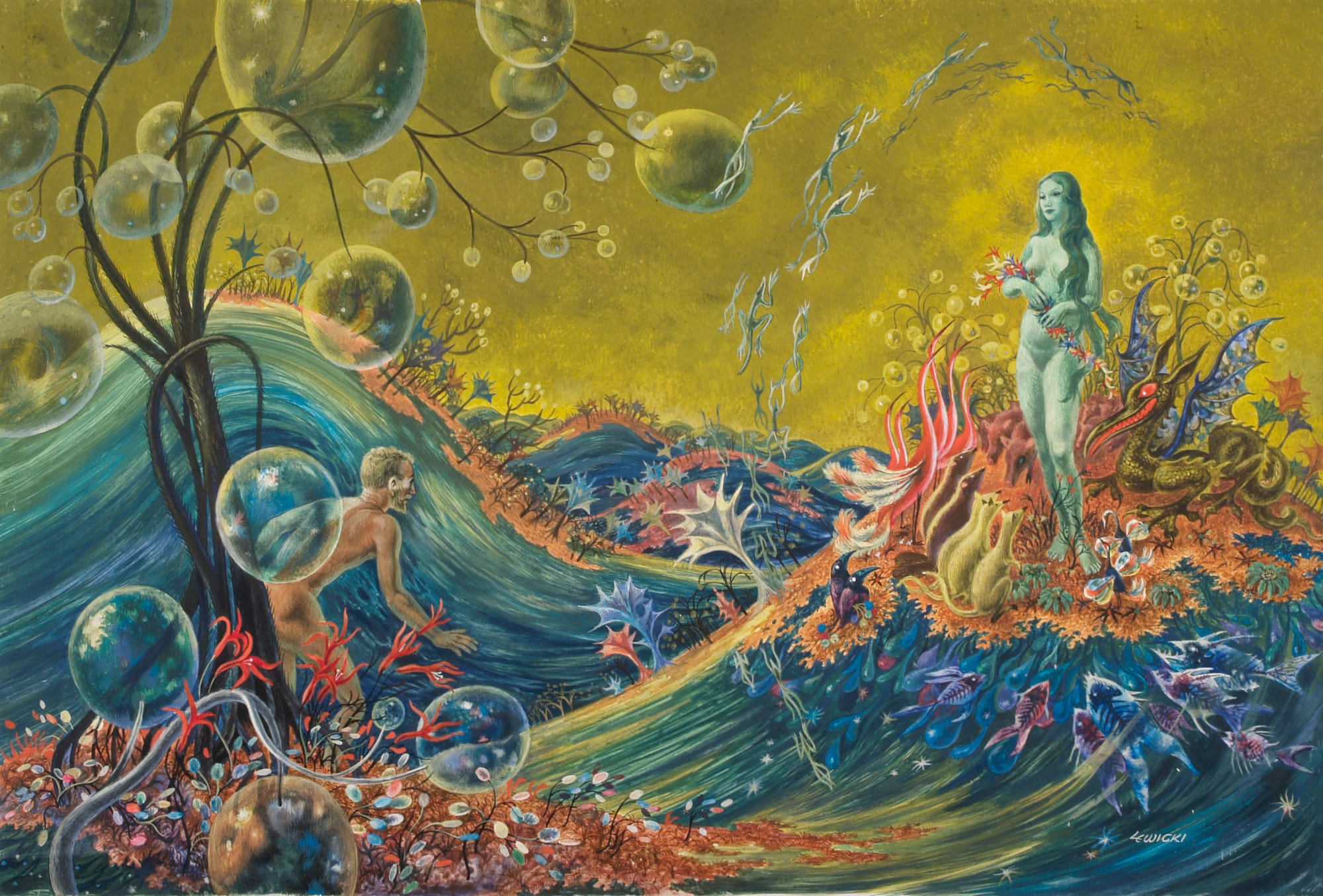
Perelandra begins with Ransom, already an experienced interplanetary traveler, being transported in the nude to the planet Venus (called “Perelandra” in the book’s fictional version of the Adamic language) by the “Oyarsa” or governing spirit of Mars. He knows only that he is to serve some purpose there in the struggle between good and evil. For a while he explores the planet alone without meeting any other characters. It’s a glorious and colorful paradise whose golden sky is compared to the background of a medieval picture, traditionally representing heavenly light. The land consists of flexible islands floating like mats over the waves of a great ocean.
The first allusion to Genesis comes when Ransom encounters trees with delicious fruit. “Of every tree of the garden thou mayest freely eat.”4 Throughout the book, fruit is used as a symbol of the good things provided by God and enjoyed by humans. One of the fruits comes in two varieties: a bland, banana-like kind of berry and a kind that looks the same externally but is extremely delicious. Ransom feels inspired to refrain from seeking out the better-tasting ones and eating only that kind, lest the pleasure of eating them be spoiled. Latter-day Saint readers may be reminded here of the similar metaphor in D&C 29:39 and Moses 6:55 about “tasting the bitter” in order to “know the sweet.” Both of these use the sense of taste to represent the way that positive experiences can be enhanced by contrast. But the meanings of Lewis’s plain fruit and of the Restoration scriptures’ bitter taste are subtly different. The verses in D&C and Moses are often associated with the doctrine of “opposition in all things” from 2 Nephi 2 and interpreted to mean that goodness is intrinsically dependent on evil, and specifically that to fully enjoy positive experiences one must know evil and have negative experiences. Lewis, however, considered joy to depend not on sorrow but on restraint and obedience. By eating the bland and the delicious berries in their natural proportion, and by showing similar restraint in eating other fruits, Ransom showed gratitude and humility towards the God that provided the fruit and was fit to fully appreciate it. In Lewis’s view, people’s inability to “know the sweet” without “tasting the bitter” is a consequence of our ungrateful, fallen nature; if we had not fallen we would not need bitterness as the healthy do not need medicine.
Having thus already learned theological lessons from the planet itself and its vegetable life, Ransom encounters for the first time a humanoid inhabitant: a green-skinned, nude woman referred to as the Green Lady who it becomes apparent is Perelandra’s equivalent of unfallen Eve.

 | A guest post by
|