

Elias: An Epic of the Ages, Canto Three: Elect of Elohim
Declare, O Muse of mightier wing, / Of loftier lore, than mine! / Why God is God, and man may be / Both human and divine;
First Light is an on-going feature highlighting early Latter-day Saint writing with speculative vibes.
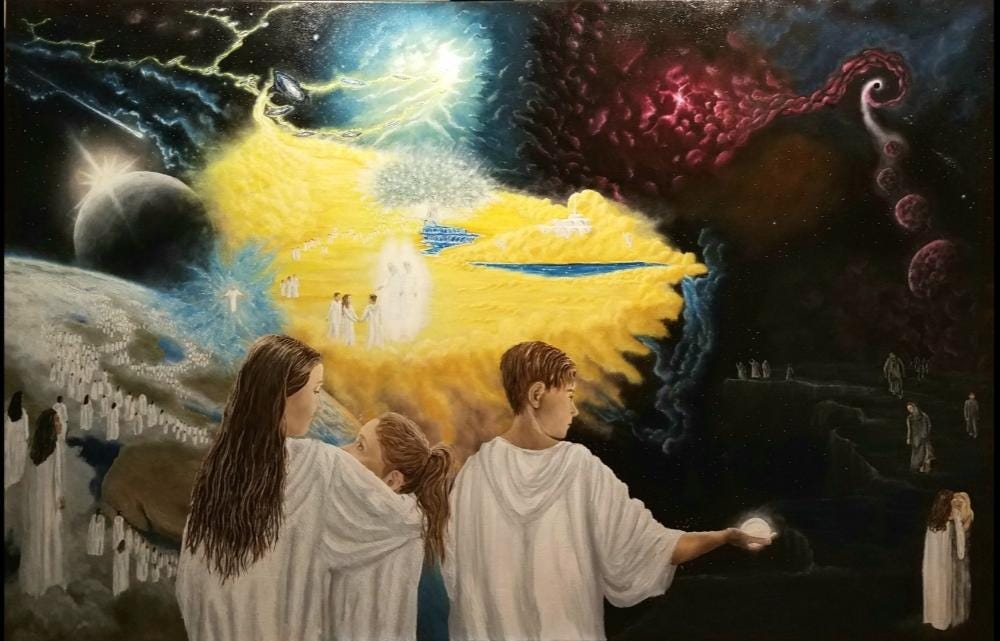
Orson F. Whitney’s Elias: An Epic of the Ages is the great Mormon epic poem of the 19th Century and, once upon a time, was well-known and widely read in Utah and nearby Latter-day Saint communities. Published just a few years before he was called to serve as an apostle in the Church of Jesus Christ of Latter-day Saints, Whitney’s work was immediately popular and, unlike most poetic works, LDS or otherwise, earned some small fame and honors for the poet in his lifetime.
Even before its official publication, however, he had begun to circulate his poem among friends and acquaintances. In December 1903, artist and critic Henry LA Culmer wrote in the Salt Lake Herald that Whitney’s poem would “rank among the finest of all literature,” comparing it to such notable works as Dante’s Divine Comedy and Milton’s Paradise Lost. Toward his own work, Whitney had a humbler attitude and said, “I do not think that I have produced an Iliad or a Paradise Lost; but neither have I attempted to do so. Elias is a ‘Mormon’ poem, upon the subject and in the spirit of ‘Mormonism.’ That is all I claim for it.”
The contents will be familiar to all Latter-day Saints. Whitney’s poem was designed to testify of the Gospel of Jesus Christ and the message of the Restoration, charting its course through the history of the Latter-day Saint people as well as through parts of what we have come to know as the Plan of Salvation. The first two cantos deal with the poet’s spiritual awakening and motivations for writing the poem. The journey, however, truly starts in Canto 3 (excerpted below), and the poet begins at the very beginning of all things, that is, in the premortal council in heaven. While any work of literature will be speculative to some extent, this canto is one of the best early examples of speculative Mormon literature as Whitney explores what that pre-mortal council may have been like.
As the poem continues, Whitney treks through Christian history and the Great Apostasy, the calling of Joseph Smith and the restoration of Christ’s church in the latter days, the coming forth of The Book of Mormon, the persecutions and migrations of the Latter-day Saints, and on into the future. The poem in its entirety can be found online for free or in a new print edition from Greg Kofford Books. Included in this issue of Further Light, you can read Theric Jepson’s review of this new critical edition, which was edited by Reid L. Neilson. I would invite all interested readers to delve into and enjoy this expansive work of early-Mormon epic poetry for themselves.
—DA Cooper, poetry editor
Elias: An Epic of the Ages
Canto Three: Elect of Elohim1
by Orson F. Whitney
Sing I a song of aeons gone,
Of life from mystery sprung,
Ere sun, or moon, or rolling stars
Their radiance earthward flung;
Ere spirit-winged intelligence
Forsook those shining spheres.
Exceeding glory there to gain
Through mortal toil and tears.
A song they learn whose lives eterne
Transcend yon twinkling night,
Pale Olea’s silver beam2 outsoar,
Shinea’s golden flight;
Passing the angel sentries by,
Mounting o’er stars and suns,
To where the orbs that govern burn,
Royal and regnant ones.
Declare, O Muse of mightier wing,
Of loftier lore, than mine!
Why God is God, and man may be
Both human and divine;
Why Sons of God, ’mid sons of men,
Unrecognized may dwell,
So masked in dense mortality
That none their truth can tell.
From worlds afar, from heavenmost star,
Heard I, or seemed to hear,
A sweet refrain, as summer rain,
A cadence soft and clear.
A voice, a harp,—Was it the same?—
Harping those harps among,
Leading the lyric universe,
On those high hills of song?
In solemn council sat the Gods;
From Kolob’s height supreme,
Celestial light blazed forth afar
O’er countless kokaubeam;
And faintest tinge, the fiery fringe
Of that resplendent day,
’Lumined the dark abysmal realm
Where earth in chaos lay.
Silence. That awful hour was one
When thought doth most avail;
Of worlds unborn the destiny
Hung trembling in the scale.
Silence self-spelled, and there arose,
Those kings and priests among,
A power sublime, than whom appeared
None nobler ’mid the throng.
A stature mingling strength with grace,
Of meek though godlike mien;
The glory of whose countenance
Outshone the noonday sheen.
Whiter his hair than ocean spray,
Or frost of alpine hill.
He spake;—attention grew more grave,
The stillness e’en more still.
“Father!” the voice like music fell,
Clear as the murmuring flow
Of mountain streamlet trickling down
From heights of virgin snow.
“Father,” it said, “since one must die,
Thy children to redeem
From spheres all formless now and void,
Where pulsing life shall teem;
“And mighty Michael3 foremost fall,
That mortal man may be;
And chosen saviour Thou must send,
Lo, here am I—send me!
I ask, I seek no recompense,
Save that which then were mine;
Mine be the willing sacrifice,
The endless glory Thine!
“Give me to lead to this lorn world,
When wandered from the fold,
Twelve legions of the noble ones
That now Thy face behold;
Tried souls,4 ’mid untried spirits found,
That captained these may be,
And crowned the dispensations all
With powers of Deity.
“Who blameless bide the spirit state,
Clothe them in mortal clay,
The stepping-stone5 to glories all,
If man will God obey,
Believing where he cannot see,
Till he again shall know,
And answer give, reward receive,
For all deeds done below.
“The love that hath redeemed all worlds6
All worlds must still redeem;
But mercy cannot justice rob—
Or where were Elohim?
Freedom—man’s faith, man’s work, God’s grace—
Must span the great gulf o’er;
Life, death, the guerdon or the doom,
Rejoice we or deplore.”
Still rang that voice, when sudden rose
Aloft a towering form,
Proudly erect as lowering peak
’Lumed by the gathering storm;
A presence bright and beautiful,
With eye of flashing fire,
A lip whose haughty curl bespoke
A sense of inward ire.
“Send me!”—coiled ’neath his courtly smile
A scarce concealed disdain—
“And none shall hence, from heaven to earth,
That shall not rise again.
My saving plan exception scorns.7
Man’s will?—Nay, mine alone.
As recompense, I claim the right
To sit on yonder Throne!”
