

A Note from the Editors: Allegory and Applicability
What’s the earliest example of fiction in Latter-day Saint literature? If we include scripture we share with other faiths, there’s a strong argument that Jotham’s parable of the trees takes the title. Contained in the book of Judges, most scholars agree it was written by no later than 1000 BC. It is also the first story in scripture that is explicitly fiction, making no claim to portray people or events from history.
Jotham’s parable is sparked by a horrific event: the massacre of almost seventy of his brothers. Abimelech, Jotham’s half-brother, convinces the people that they would be better off ruled by a single king rather than led by a group of judges. The people give Abimelech money, and he uses it to hire a band of thugs who murder almost all of his brothers. Only one escapes: Jotham. When the people gather to crown Abimelech king, Jotham emerges from hiding to tell this story:
The trees went forth on a time to anoint a king over them; and they said unto the olive tree, “Reign thou over us.”
But the olive tree said unto them, “Should I leave my fatness, wherewith by me they honour God and man, and go to be promoted over the trees?”
And the trees said to the fig tree, “Come thou, and reign over us.”
But the fig tree said unto them, “Should I forsake my sweetness, and my good fruit, and go to be promoted over the trees?”
Then said the trees unto the vine, “Come thou, and reign over us.”
And the vine said unto them, “Should I leave my wine, which cheereth God and man, and go to be promoted over the trees?”
Then said all the trees unto the bramble, “Come thou, and reign over us.”
And the bramble said unto the trees, “If in truth ye anoint me king over you, then come and put your trust in my shadow: and if not, let fire come out of the bramble, and devour the cedars of Lebanon.” (Judges 9:8-15, KJV)
Not only is this story fiction, but it has talking trees. It’s fantasy!
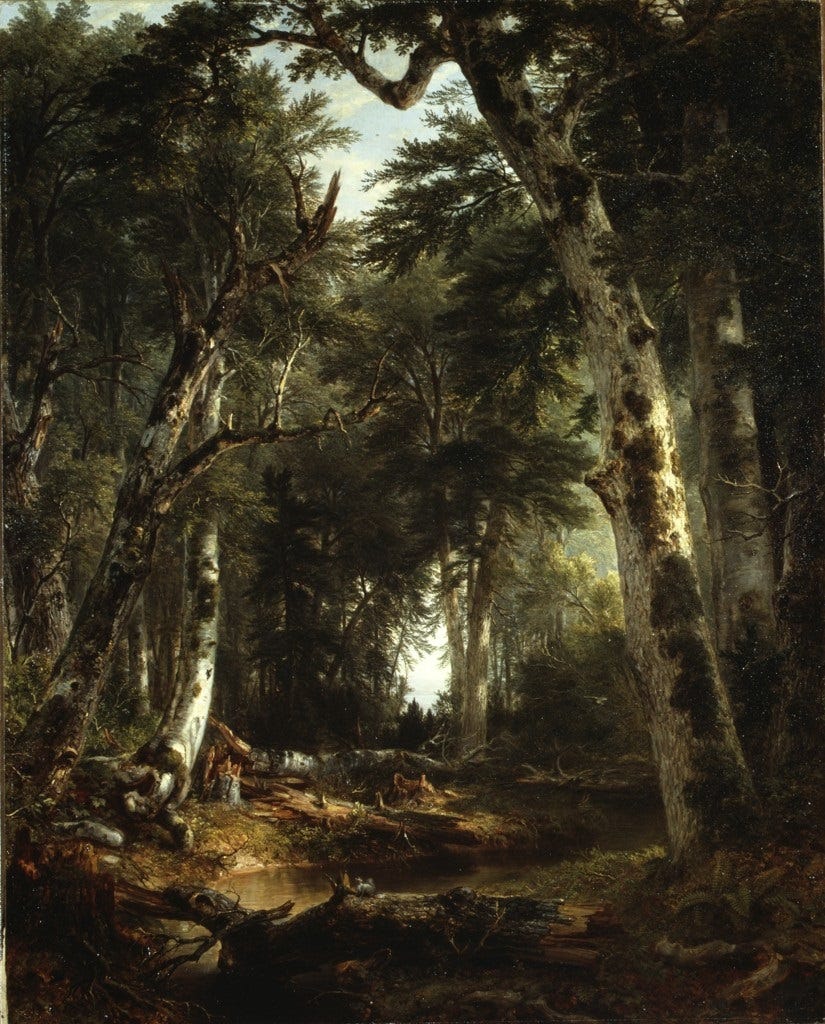
Now, Jotham could have stood on that mountain and said, “Abimelech is a terrible person who murdered sixty-nine of my brothers. Don’t make such a violent man king.” Instead, he told this fantastic parable. Why? One reason might be that it was more entertaining than a rant against this powerful man, which the people may have heard before. Powerful men inspire a lot of rants, especially powerful men who do terrible things to gain power and seem to escape any consequences. A message is undoubtedly more engaging couched as a compelling story than as a rant.
Why fiction, though? Jotham might have said, “The gravity of this moment demands straight talk.” More than entertainment, the use of talking trees puts distance between his listeners and their actions, distance that Jotham hoped would allow them to get perspective. With that perspective, perhaps they would make a different choice.
A well-done story in any genre can create that separation, allowing us to see aspects of our lives today from the perspective of someone from the past; someone of a different ethnic, religious, or national background; from the perspective of a doctor or tech entrepreneur or detective.
But speculative fiction can do even more. It doesn’t just take us out of our current position in life; it also takes us away from the limitations of our current reality. Whether it’s an alternate history, the distant future, a faraway planet, or a world with magical laws of nature, speculative fiction lets us see the endless possibilities of the human soul that might otherwise be invisible.
As Further Light editors, one thing we hope readers find in the stories we pick is this: the best stories don’t preach to us. Rather than tell us in so many words how foolish we are, these stories explore the choices people (or trees) make and what follows. As JRR Tolkien famously wrote, “I cordially dislike allegory in all its manifestations [. . .]. I much prefer history, true or feigned, with its varied applicability to the thought and experience of readers.”1
What separates applicability from allegory? The rest of the quote provides a key: “[T]he one resides in the freedom of the reader, and the other in the purposed domination of the author.”2 A quality story—one that we read and reread and pass on to our friends and family—doesn’t tell us what to think. Nor does it simply tell us what happened to a group of characters. It leaves space to see ourselves in it. It asks interesting questions, trusting the reader to connect the dots and, perhaps, even leaves a few more for the reader to answer on their own.
Perhaps you can’t see yourself among the talking trees or with Tolkien. Perhaps you’re over epic fantasy and roll your eyes at all the Brandon Sanderson fans. Fortunately, as the Book of Mormon teaches, God speaks to us “in [our] own tongue” (Alma 29:8). We’ve drawn from a variety of genres and styles, hoping that you can find your own “nation and tongue” here. There are vampires (we have four in this issue!). If you’re not into vampires, there’s steampunk (“Opera of the Abyss”). If that’s not your thing, there’s science fiction (“Emergence”). Part of the wonder of speculative fiction is how much you can do with it! It can range from light-hearted (“Meanwhile in Paradise”) to heart-breaking (“The Archaemaji”).
As the Hebrew prophet Micah put it, “But they shall sit every man under his vine and under his fig tree; And none shall make them afraid” (Micah 4:4). Speculative fiction can be those fig trees for us, something that provides shade from the heat of this world, sustenance through the truths it can reveal, and sweetness to our lives because we deserve a little fun along the way. We hope that you find a vine or fig tree here, one whose fruit will lead you on to further light.
—Stephen Pulsipher & Neal Silvester
Issue 2 Cover and Contents Reveal
And now the moment you’ve been waiting for! Here is your first look at the cover of issue 2 of Further Light, with art by Eternity Stovall, and the online publication schedule for our first issue.
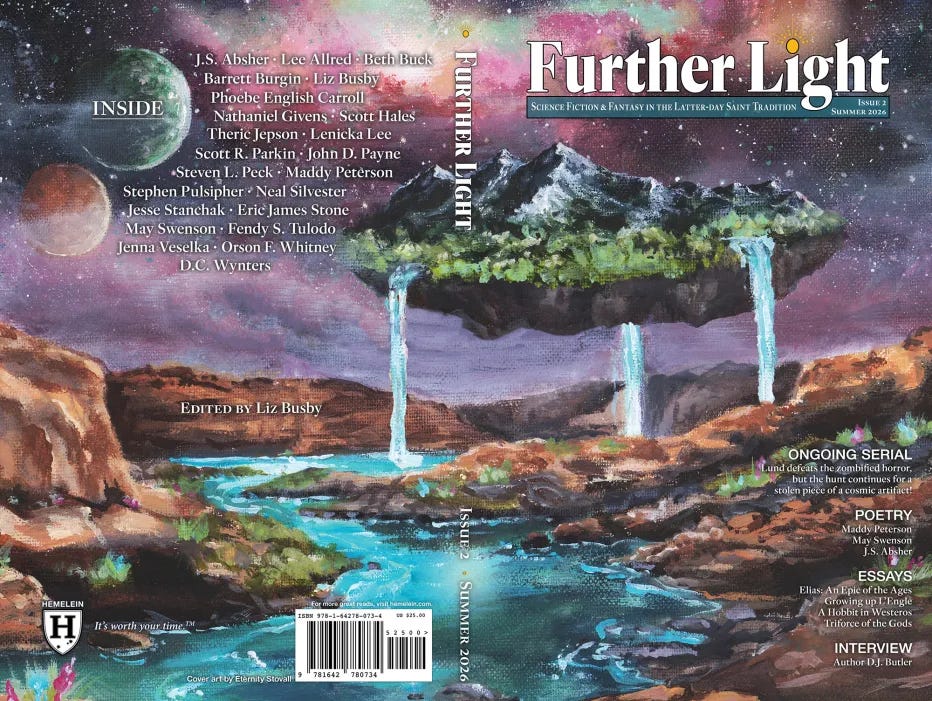
About the Artist:
ETERNITY STOVALL recently graduated from BYU with a bachelor of arts. She paints with mediums such as acrylic, watercolor, and oils. She enjoys trying new mediums and styles. Her work is focused on expressing her faith, and increasing diversity, and inclusion within her community. She desires to create works that inspire and bring joy to others.
Issue 2 Publication Schedule:
Jul 14 - Fiction - “Emergence” by Steven L. Peck
Jul 21 - Fiction - “Push the Button, Jennis” by Beth Buck
Jul 28 - Poetry - Elias: An Epic of the Ages, Canto Three: “The Elect of Elohim” by Orson F. Whitney (with an introduction by DA Cooper)
Jul 28 - Essay - “God’s Ammunition Is Not Exhausted: on a new edition of Elias: An Epic of the Ages” by Theric Jepson
Aug 4 - Poetry - “Meanwhile, in Paradise” by Maddy Peterson
Aug 11 - Fiction - “Salt of Judas” by Eric James Stone
Aug 18 - Essay - “Martin’s Diabolus Ex Machina: A Hobbit in Westeros” by Nathaniel Givens
Aug 25 - Fiction - “Opera of the Abyss, Part II: A Fright at the Opera” by Lee Allred
Sep 8 - Fiction - “Brine Under the Y” by Fendy S. Tulodo
Sep 15 - Interview - “Crossing the Boundaries of One Universe and Entering Another: An Interview with DJ Butler” by John D. Payne
Sep 22 - Poetry - “The Beam” by May Swenson
Sep 29 - Fiction - “The Archaemaji” by DC Wynters
For the month of October, Further Light presents: A Coven of Mormon Vampires
Oct 6 - Flash Fiction - “Knock Knock” by Jesse Stanchak
Oct 13 - Fiction - “All Are Alike unto God” by Lenicka Lee
Oct 20 - Fiction - “Blood of This Generation” by Scott R. Parkin
Oct 27 - Fiction - “The Kovacs” by Phoebe English Carroll
Nov 3 - Essay - “Triforce of the Gods: A Sacred Realm of New Media” by Barrett Burgin
Nov 10 - Fiction - “Repatriation” by Scott Hales
Nov 17 - Poetry - “Bedtime Story for a Winter Night” by JS Absher
Dec 1 - Fiction - “And with Twain She Did Fly” by John D. Payne
Dec 8 - Essay - “Growing Up L’Engle” by Liz Busby
Dec 15 - Poetry - “A Christmas on Kivu” by JS Absher
Dec 22 - Tempting the Saints - “Nettlewart’s First Patient” by Jenna Veselka
Can’t wait to read your new favorite story? Subscribe by the end of July to get the print edition containing all 23 pieces as soon as it’s available!

July 2026 Newsblotter
As part of Further Light’s mission to gather together a community who is interested in the conversation about LDS speculative fiction, we publish a free monthly-ish roundup of news, events, and interesting publications. If we missed something that you think should be included, please drop us a note!
Interesting Publications
The biggest speculative Mormon lit news in July is that Steven Peck's A Short Stay in Hell has been made part of the Penguin Vintage Classics series. Coverage about what this means for Mormon literature in general in the Salt Lake Tribune, Religion News, and Wayfare Magazine.
YouTube channel Keystone has a great analysis of sacred clothing traditions across multiple religions. It put us in mind of how sacred clothing shows up in the Mandalorian’s commitment to wearing their armor. We would love to see an essay using the series to contextualize the current discourse about the garment. Or perhaps you can think of another fantasy or sci-fi book that uses sacred clothing?
In case you missed it, Brandon Sanderson was invited to give this year’s Tolkien Lecture on Fantasy Literature at Oxford. He provides some great commentary on exactly what it was that Tolkien did to revolutionize the genre and how writers after him have used or neglected those innovations. Really fun to hear Professor Sanderson come out to play!
Eric Falden’s “Denethor, Lord of Doom-Scrolling” makes a great case the Lord of the Rings can teach us something about the damage being done by social media. You’ll never see your smartphone in the same way again.
Read something great that we should know about? Send links to editor@furtherlightmag.com with the subject line “Interesting Publications.”
Community Events
June 5-July 11 - Lore: The Power of Stories - Only a few more days to visit The Compass Gallery’s annual fantasy show. You won’t want to miss this exhibit, so check their hours and plan to come view amazing fantasy art with spiritual significance. Plus you can flip through issue 1 of Further Light, on sale in the book section!
July 6-12 - Vote in the 15th Annual Mormon Lit Blitz - Now’s the time to vote in the Mormon Lit Blitz and help your favorite piece win the Audience Choice award! This year’s finalists include two fantastic speculative pieces: “In My Father’s House Are Many Rooms” by Janci Patterson and “Lucy & Ida at the End Times” by William Morris. Read or listen to all the finalists and place your votes, then come back for the announcement of the winners on July 13.
July 17-18 - Writers Cantina - Join local Utah authors for a casual and inexpensive event in West Valley City.
August 17–21 - BYU Education Week - We happen to know there will be a track on science fiction and theology that you don’t want to miss!
Got an event we missed? Send information to editor@furtherlightmag.com with the subject line “Community Events.”
Submissions & Deadlines
July 20 - Submit to Infinite Valley’s American fantasy issue - Our other favorite LDS SFF magazine is collecting for an “American Dreams” issue right now. Submit your America-inspired fantasy, sci-fi, or alternate history short story to be considered for the issue!
Aug 1 - Enter Wayfare’s short play competition - Wayfare Magazine is hosting its third annual short play competition. We loved the winners of previous years, some of which incorporated some speculativeness. Maybe you’ll try your hand at it?
August 31 - Submit to Further Light issue 3 - Submissions continue to roll in! We are always in need of more poetry that includes fantastical elements and isn’t preachy. And we would particularly love to receive nonfiction essays discussing Harry Potter, Dune Messiah, and The Magician’s Nephew, which all have major new adaptations coming up. Another subject we’d love to see examined is Latter-day Saint speculative fiction that involves the Salt Lake Temple, like Orson Scott Card’s classic short story “Salvage” or Mette Ivie Harrison’s Vampires in the Temple.
Aug 31 - Wow readers with your first 1000 words - Utah literacy conference StoryCon is hosting a first 1000 words contest. Entry fee is $29, but all entries get a critique by a professional writer. Age brackets for teens age 13-15, teens age 16-19, and adults 20 and up.
October 1 - Send in a paper to LTUE - Got something clever to say about your favorite science fiction or fantasy property? Submit an essay to LTUE’s academic track to share your thoughts with everyone (and get free conference admission and snacks in the green room—seriously, those mini eclairs are worth it).
Got an opportunity we missed? Send information to editor@furtherlightmag.com with the subject line “Submissions & Deadlines.”
JRR Tolkien, forward to the second edition of The Lord of the Rings (Houghton Mifflin, 1994), xv.
Tolkien, forward, xv.