Journey Before Destination, Faith Before Certainty
Experiencing Belief in Wind and Truth

This essay contains spoilers for the first arc of the Stormlight Archive.
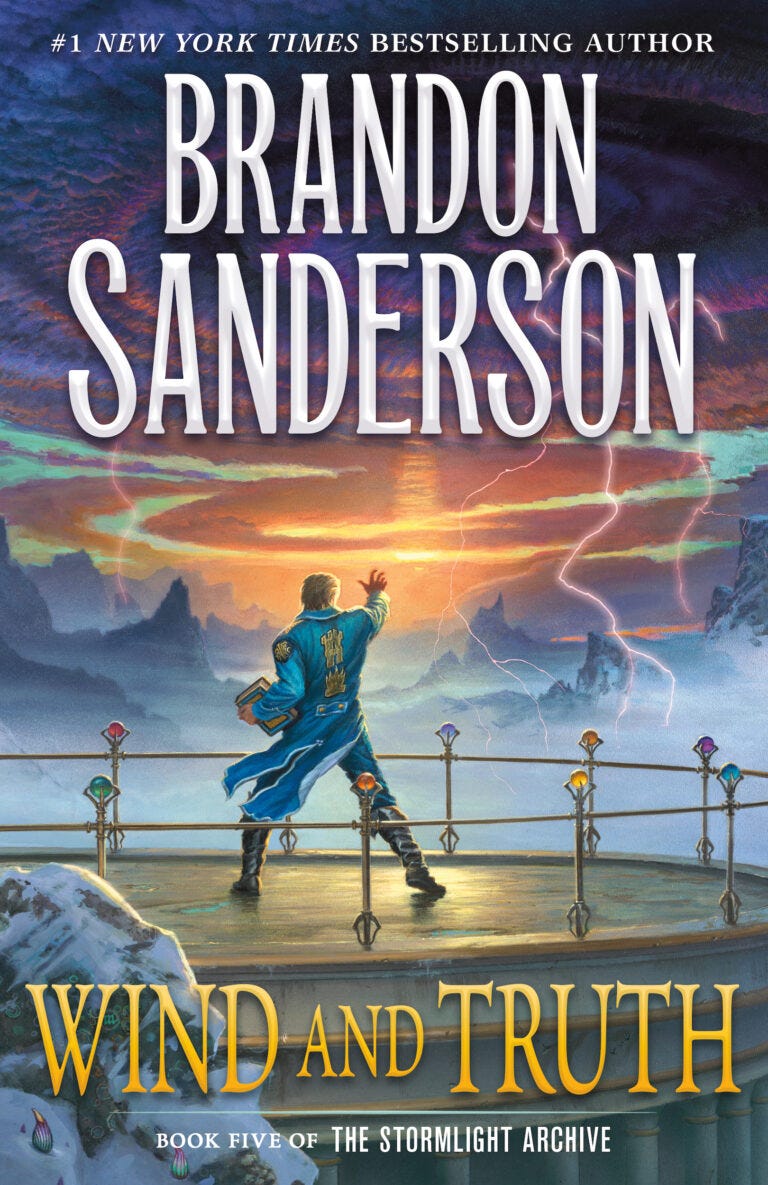
I don’t think it would be incorrect to say that Wind and Truth is Brandon Sanderson’s most controversial book to date. Part of this is the sheer length of the volume: the more-than-1300 pages stretch the patience of even hardcore fans of epic fantasy. Though previous volumes have also been behemoths, this one also felt it, with a plot that rushed readers from one side of Roshar to the other and yet seemed at the same time to drag on and on. Many readers of Wind and Truth noticed a certain repetitiveness to Sanderson’s language, leading to the thought that Sanderson’s editors ought to have done more cutting. An irritating increase in modernisms also placed this book out of sync with previous works in the series. Characters who were “courting” in previous books are now said to be “dating” and eventually become “exes.” In a society where the majority of people don’t have watches or clocks, a character tells another to wait “just a sec.”
One particularly awkward example of this trend is the insertion of the modern concept of “therapy” into the book’s medieval/early Renaissance-ish setting. While these characters have always been identifiable as suffering from mental illness, the in-world language tended to be archaic— “battle shock,” “melancholia.” In the previous volume, Kaladin invented the idea of group talk therapy but never referred to it as anything other than being a different kind of “surgeon.” In Wind and Truth, however, the term “therapist” appears as the punchline of a joke at an otherwise climactic moment. Granted, it’s introduced by Hoid, a character who has reason to know more modern terminology, but the contrast has been jarring to many readers. If the goal of fantasy is to be immersive, the sprinkling of modern language in this book breaks that immersion.
Do these imperfections mean Wind and Truth is doomed to be remembered as a rushed and forgettable mid-season finale in the Stormlight Archive? During the last year, I’ve wrestled through the book a second time, and I’ve come to believe that if we can look beyond some of its rough edges, the fifth volume of the Stormlight Archive may be one of the most profound books in the series. Wind and Truth asks many questions that, to me, seem directly attached to deeply Latter-day Saint theology. And it answers these questions in ways that are particularly insightful into how faith operates in the modern world.