

Introducing Issue 1 & January 2026 Newsblotter
Revealing our cover and the contents of our first issue
A Note from the Editor
In some ways, this magazine began back in the fall of 2007 at BYU when I first took a course on the Literature of the Latter-day Saints. Though that class mostly centered around realistic fiction and poetry, as a proper nerd, I convinced my instructor to let me write my final paper about the history of Latter-day Saints in science fiction. I spent hours in the library digging into articles about Orson Scott Card and Battlestar Galactica, as well as discussions of Mormon cameos in novels by Robert Heinlein and Piers Anthony.1 This was just as the pop culture world was becoming familiar with the name Stephenie Meyer and long before most people had heard of Brandon Sanderson. My brief glimpse into the world of the LDS fantastic electrified my imagination. I had grown up reading Card’s novels and enjoyed the idea that he was one of us—as all minorities take pleasure in the hometown boy who made good—but until that point I had never really thought about the potential of science fiction and fantasy as a particularly Latter-day Saint genre. For me, the connection was now clear: unlike the polygamy novels we read in class which seemingly dealt with only angst, complication, and doubt, or the devotional novels that skimmed the surface of what it meant to be a good Latter-day Saint, our fantastic literature was able to dive into the revolutionary perspective of the Restoration, the way that our unorthodox view on so many theological questions opened up an expansive space for human potential, to examine the implications of what it means to believe radically.
Every few years since then (at least it seems so to me as someone who had a vested interest), a major news outlet discovered the prevalence and success of fantasy and science fiction writing in Utah and felt compelled to investigate, often because a major motion picture based on a novel written by a Latter-day Saint was about to be released. These reports usually gestured at the uniqueness of our theology—our belief in other inhabited worlds, in modern revelation, in human potential and theosis—as somehow priming us to write about the fantastic. Some pointed to our conservative culture and saw genre fiction as hearkening back to a simpler time where our values were more accepted, avoiding dealing with the more realistic and depressing themes of “real” literature. Some even concluded that for people writing about aliens and magic, we were disappointingly boring and family-oriented and liked an inordinate amount of salt on our food.2 Of course, there is truth to all of these things (especially the salt one—my grandmother kept a saltshaker in her purse for emergencies). But these outside perspectives never seemed to capture that vision I had glimpsed as an undergrad of how the fantastic could bring Latter-day Saint theology from the background to center stage, giving the author and the reader room to really examine the immense possibilities and intense implications of the Restoration.
Of course, all through this time there have actually been Latter-day Saints—authors, fans, scholars—writing about how genre fiction illuminates the gospel and producing fantastical stories with a deeply Restorationist worldview. But their work has been scattered through various blogs, academic and literary journals, and fan websites. I could find them because I was constantly prowling the internet for just such things, but to the average Latter-day Saint, none of it was accessible.
This magazine was born out of a desire to have somewhere clear to send people when I talk about Latter-day Saints and speculative fiction and they ask where they can go for more. The goal of Further Light is to be a center of gravity for all things about Latter-day Saints and the fantastic. In these pages, we hope to move beyond the standard question of why there are so many Mormon characters in science fiction, and instead show how a science fiction story can be radically transformed when its Latter-day Saint characters are deeper than the aesthetics of a nametag and a smile. Instead of asking why so many LDS authors turn to writing fantasy, we will explore what we learn about the Restoration perspective on the divine by examining it through the lens of myth and subcreation. Instead of asking why not instead write something realistic and faith-promoting (as some unfortunately still do), we will unearth when Latter-day Saint speculative fiction actually got started by publishing works from earlier authors that show that Latter-day Saint fiction has in some ways always been speculative fiction.
Of course, selfishly, my hope is that the existence of this magazine will also incentivize the creation of new Latter-day Saint science fiction and fantasy, work that engages with the edge cases of our theological knowledge and pushes on the gap between our culture as it exists and as it needs to be. Speculative fiction is a great tool for asking questions that don’t have tidy answers, and I believe that our work doesn’t have to be didactic in order to take faith seriously. I hope that the weirdness of science fiction and the mythic quality of fantasy create a place where faith and complexity can exist side by side, where we can wrestle with the angels of the Restoration, where questions don’t always lead to a loss of belief but a deepening of it.
The pieces in this first issue represent a wide range of genres, tones, and styles. They range from alternate history to magical realism, from an analysis of popular authors and streaming series to riffs on classic literature, from humorous and hopeful to dark and uncertain. As you read, I hope you find your mind and faith expanded and enjoy this first step in our journey towards further light.
Liz Busby
Editor-in-Chief
Issue 1 Cover and Contents Reveal
And now the moment you’ve been waiting for! Here is your first look at the cover of issue 1 of Further Light, with art by Emily E. Jones, and the online publication schedule for our first issue. Note that the cover will continue to develop as we move towards publication, but we wanted to get things rolling with our online version this week.
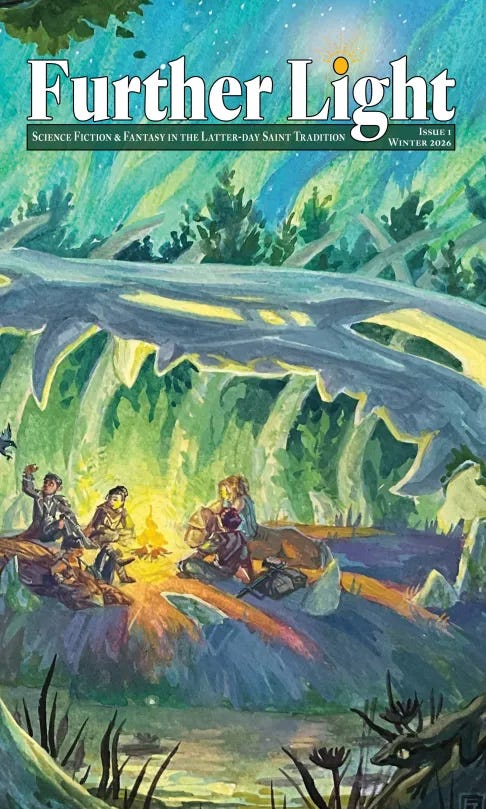
About the Artist: EMILY E. JONES is a freelance illustrator currently residing in northern Utah, after receiving her Bachelor of Fine Arts from Brigham Young University in 2022. She aims to enchant with a variety of both traditional and digital illustrations, many of them whimsical and fantasy-themed. Emily has always been an avid reader as well, and loves to tell visual stories based on the books that inspire her! Her favorite things are cats, pastries, not-too-long hikes, playing piano, and finding wonder in the everyday. Find more of her work on theartofemilye.com.
Issue 1 Publication Schedule:
Jan 13 - “Opera of the Abyss, Part 1: Murder and the Rue Morgue” by Lee Allred
Jan 20 - “Harmony and the Problem of Evil” by DC Wynters
Jan 27 - “Ivy” by Sadie Marie Hutchings
Feb 3 - “Commitment” by Brian K. Lowe
Feb 17 - “The Double-Snatcher” by WO Hemsath
Feb 24 - “The Man Who Came Back from the Lunar Colony” by Orson Scott Card
Mar 3 - “A Latter-day Saint Reading of CS Lewis’s Perelandra” by Cameron Price
Mar 10 - “The Fallen” by DA Cooper
Mar 17 - “Charity Never Faileth” by Jaleta Clegg
Mar 31 - “Journey Before Destination, Faith Before Certainty: Experiencing Belief in Wind and Truth” by Liz Busby
Apr 7 - “Young Hagoth Plays It Safe” by Theric Jepson
Apr 14 - “Rented Room” by JS Absher
Apr 21 - “Music of the Spirit” by Annaliese Lemmon
Apr 28 - “Why Andor’s Grown-Up Heroes Matter to Faithful Adults” by Alan Hurst
May 5 - “Carta del Cap. Robert Walton a José Smith”/”A Letter from Captain Robert Walton to Joseph Smith” by R. de la Lanza
May 12 - “From a Spirit to the One Possessed” by Orson Scott Card
May 26 - “Voices from the Dust” by Jeanna Mason Stay
Jun 2 - “Grandmother’s Rocking Chair” by Nephi Anderson, with introduction by Kent Larson
Jun 9 - “Aslan or Qslan? Insights into Latter-day Saint Cosmology from the Sci-fi/Fantasy Divide” by Jeffrey Thayne and Jacob Ross
Jun 16 - “Death” by Carol Lynn Pearson
Jun 23 - “The Mothers” by Chanel Earl
Jun 30 - “The Enemy Has a Body: A Confidential Memo” by Jordan Lake
Can’t wait to read your new favorite story? Subscribe now to get the print edition containing all 22 pieces as soon as it’s available!

January 2026 Newsblotter
As part of Further Light’s mission to gather together a community who is interested in the conversation about LDS speculative fiction, we publish a free monthly-ish roundup of news, events, and interesting publications. If we missed something that you think should be included, please drop us a note!
Interesting Publications
Fantasy fans might recognize a few of the locations Nephi visits in Mario Montani’s “Tres Jornadas Intertextuales de Nephi”/“Three Days of Nephi’s Intertextual Travels” from Wayfare Magazine.
YouTube channel Marvelous Wonder put together a compelling explanation of the temple endowment through the Superman movie Man of Steel (2013).
Elissa Nysetvold wrote about KPop Demon Hunters as “the feel-good Christian movie of the year” for its portrayal of the need for redemption.
Further Light editor Jeremiah Scanlan wrote about belonging, building community, and his experience at Dragonsteel Nexus for Wayfare Magazine.
Saints & Cinephiles published an interview with Michael Bahnmiller, who produced the cinematic album Kaladin inspired by The Way of Kings. Someday we'll get a movie of the Stormlight Archive, but until then, Kaladin is the next best thing. We enjoyed learning about all the effort that went into conceptualizing and producing the album.
Read something great that we should know about? Send links to editor@furtherlightmag.com with the subject line “Interesting Publications.”

Community Events
Feb 12-14 - Life, the Universe, and Everything 44 - Utah’s longest running science fiction and fantasy symposium. The Guests of Honor are Ron Clements (writer and director of The Little Mermaid, Aladdin, and my brother’s favorite Treasure Planet), Charlie N. Holmberg (writer of many fantastic fantasy romance series), and Matt Dinniman (of Dungeon Crawler Carl fame). LTUE is a great place to meet favorite authors, form a writing group, or pitch your novel. Registration is $90, with a special $15 ticket for students. We hope to see you there!
Feb 27-28 - StoryCon 2026 - A national convention celebrating the power of story held in Salt Lake City. Several LDS speculative authors are speaking including Brandon Sanderson. We’ve never been, so if you go, be sure to tell us about it!
Got an event we missed? Send information to editor@furtherlightmag.com with the subject line “Community Events.”

Submissions & Deadlines
Jan 31 - Submit your temple-themed work to Irreantum - Their Temple issue is collecting through the end of the month.
Feb 1 - Submit to Still Small Stories - Fellow LDS Substack publication Still Small Stories is open for submissions. They are definitely open to speculative work and pay $50 per story, so make sure to send something in!
Feb 28 - Submit to Further Light issue 2 - Send in your work to be included in Further Light’s second issue! Besides what’s listed on our usual Call for Submissions page, we'd specifically like to see more fiction in the genres of space opera and secondary world fantasy. Don’t be afraid to do something wild! We are also always in need of interesting nonfiction, so compose your thoughts about the gospel and your favorite tv series or novel, especially if it’s not Brandon Sanderson. (Still send it in if it is about Sanderson; we love the Cosmere, but we also need some variety in subject matter.)
Apr 26 - Get your art into The Compass Gallery - This one is for our artist friends: The Compass Gallery is hosting another exhibit of fantasy art this summer titled “Lore: The Power of Stories”! After visiting their “Fantastically Human” exhibit last year, we know this one’s gonna be great. Submit your art to be exhibited alongside Steve Argyle and Howard Lyon.
July 20 - Write a review of a fake piece of LDS art - Irreantum is collecting new pieces for a special themed issue of reviews of LDS art. The catch is that these works don’t exist yet. Check out this fake review of a (speculative?) novel written by Brigham Young as an example. I’m hoping for a review of a magical installation or perhaps some space-based performance art.
Got an opportunity we missed? Send information to editor@furtherlightmag.com with the subject line “Submissions & Deadlines.”
The best article at the time was Michael R. Collings’s “Refracted Visions and Future Worlds: Mormonism and Science Fiction,” Dialogue: A Journal of Mormon Thought 17, no. 3 (1984): 107–16. There’s also a fantastic reply from Orson Scott Card in volume 18, no. 2.
Jason Kehe, “Brandon Sanderson is Your God,” Wired.com, Mar 23, 2023.